
Two nights ago, at the State of the Union, the President of the United States turned to the opposition party and demanded they stand to prove their loyalty — then called them “crazy” and said they were “destroying our country.” The same week, the Century Foundation reported that American democracy scored 57 out of 100 in 2025, down from 79 the year before — a 28 percent collapse in a single year. Yesterday, the US Treasury sanctioned five Nicaraguan officials for enabling what it called the “Murillo-Ortega dictatorship’s repression.”
I’ve been watching this pattern for years. I lived inside it once. And I wrote a novel about it.
The question that drives my novel The Comandante’s Shadow is a simple one, and I’ve never found a satisfying answer:
How does someone who risked everything for freedom become someone who takes freedom away?
I don’t ask this as a journalist or an academic. I ask it as someone who was there.
I was there
In the early 1980s, I went to Nicaragua. Like many Latin Americans of my generation, I went to see the revolution up close — to harvest coffee, to witness what felt like the most hopeful political experiment in the hemisphere. The Sandinista revolution had overthrown the Somoza dictatorship in 1979, and for a brief, extraordinary moment, it felt like proof that something better was possible.
I stayed. Almost three years.
I saw the literacy campaigns — thousands of young volunteers fanning out into the countryside to teach people to read. I saw the land reforms. I saw the health brigades. I also saw the war the United States was funding against all of it, the Contra war that bled the country dry and gave the government its first excuse to tighten control.
And I saw, even then, the early signs of something else. The concentration of power. The silencing of internal critics. The gap between the revolutionary language and what was actually happening in the rooms where decisions were made. The revolution was being betrayed — slowly, from the inside — by greed, by corruption, by the intoxication of power.
I left in 1987. The revolution lost the 1990 election. Ortega spent sixteen years in opposition, making deals with the very people the revolution was supposed to have displaced.
And then he came back.
The full revolution — back to where it started
Daniel Ortega returned to power in 2006. By 2026, he has been in power for nineteen consecutive years — longer than Somoza, the dictator he helped overthrow. He now shares the presidency with his wife, Rosario Murillo, under a constitution rewritten to create a dynastic co-presidency. His son, an opera singer with no diplomatic training, manages relations with China. Just last month, Nicaragua’s rubber-stamp National Assembly eliminated dual citizenship — not for any practical reason, but to sever exiled dissidents from any remaining legal tie to the country they were forced to flee.
Human rights violations in Nicaragua increased 230 percent between December 2025 and January 2026. Journalists have fled. Thousands of NGOs have been shuttered. Universities have lost their autonomy. The Catholic Church has been repressed. Political prisoners are held in conditions that amount to enforced disappearance. Nicaragua is now called “the tropical North Korea,” and the comparison is not hyperbole.
Ortega is now worse than the dictator he deposed. That sentence took me years to be able to write.
How does someone make that turn? A full revolution — in the literal sense — going all the way back to where it started? Or worse?
The pattern
In writing the novel, I noticed the same stages in case after case. I’m not the first to notice them — scholars of democratic backsliding have written extensively about this — but seeing them refracted through one specific life made them vivid in a way that academic analysis often doesn’t.
First: the genuine grievance. Almost no authoritarian leader begins as a monster. Ortega’s early life was shaped by the Somoza dictatorship’s brutality. Mugabe led a genuine liberation movement against a racist colonial government. Chávez emerged from one of Latin America’s most corrupt and unequal societies. Trump harnessed the disillusionment with the political establishment in the U.S. The grievance is real.
Second: the years in power when the movement’s idealism and the government’s pragmatism are genuinely in tension. The Sandinista literacy campaign was real and remarkable. The land reforms benefited real people. This phase is the cruelest part of the story, because it makes what comes later feel like a betrayal of something that was actually good.
Third: the threat — real or manufactured — that justifies the first compromise. “We can’t let them take back what we’ve built.” This is the hinge moment. Every authoritarian has a version of this sentence.
Fourth: the machinery. Once the first democratic norm is violated, the next violation is easier. The press that criticizes you becomes “foreign-funded destabilization.” The opponents who challenge you become “coup plotters.” The constitution that limits you gets rewritten.
Fifth: the language of liberation, preserved long after the liberation ends. This is the part that I find most disturbing, and the part I spent the most time with in the novel. The vocabulary of justice gets repurposed to justify injustice. It happens so gradually that many people who once believed in the movement continue to defend it, because the words still sound like the thing they loved.
Why this pattern matters right now
Read that five-stage sequence again. Then think about what’s happening in the United States in 2026.
The genuine grievance — real economic pain, real institutional failure, real communities that felt abandoned. The early actions that benefited real people and generated real loyalty. The manufactured threats — “invasions” at the border, “enemies within.” The machinery — courts ignored, agencies gutted, the press labeled the enemy, the constitution treated as an obstacle. And the language: “freedom,” “patriotism,” “the people” — words that still sound like the thing millions of Americans loved, repurposed daily to justify its opposite.
I wrote another novel about exactly this. The Tides of Freedom follows a constitutional scholar on a fictional Caribbean island nation as she watches a populist leader rise to power, dismantle democratic institutions one policy at a time, and transform citizens into non-persons. That novel — and what it says about the American trajectory — will be the subject of a future post.
But The Comandante’s Shadow came first, because Nicaragua came first for me.
Why I wrote this as a novel rather than an essay
Because essays don’t show you what it feels like from the inside.
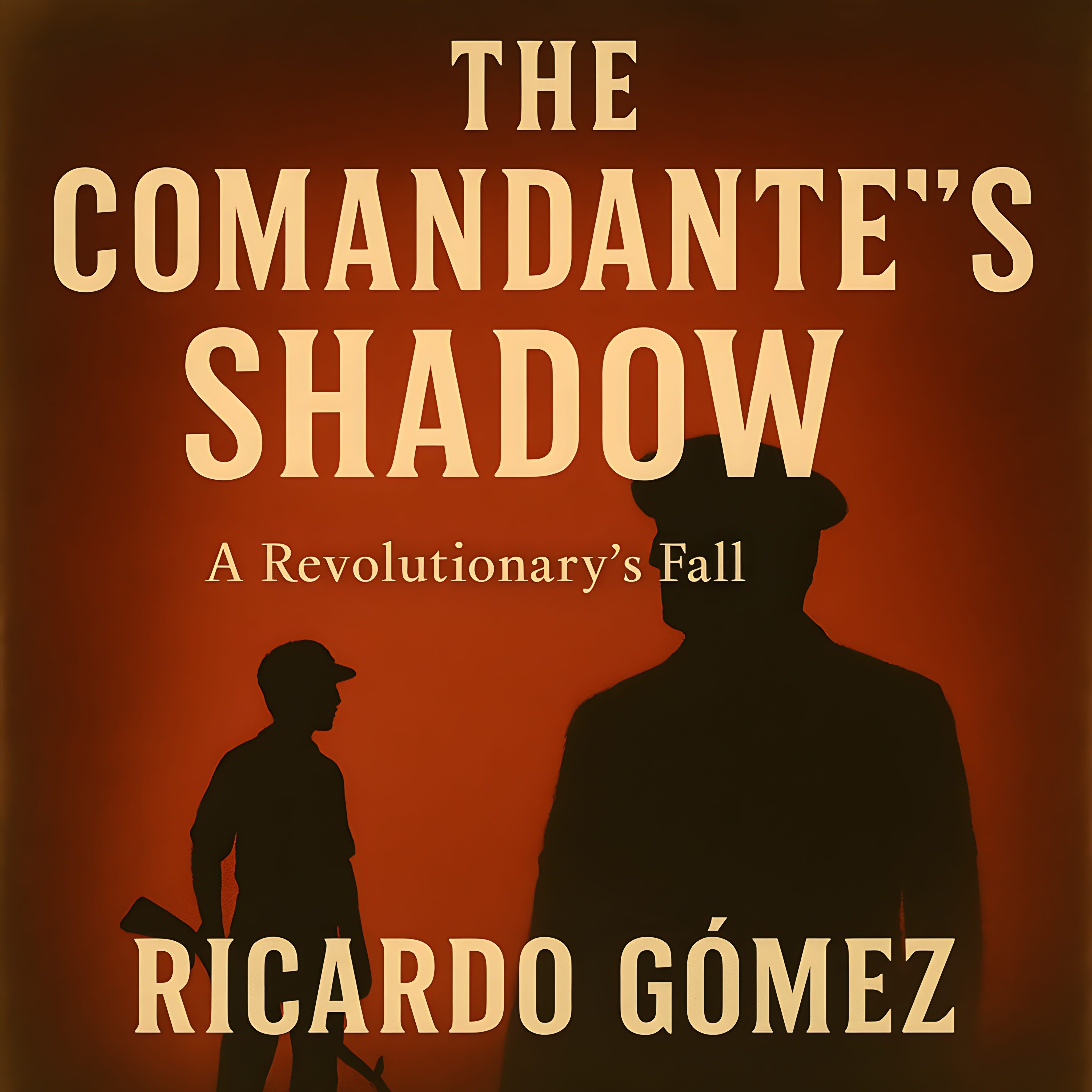
The narrator of The Comandante’s Shadow is an American teacher who arrives in Nicaragua in the 1980s and stays for years. She’s not naive — but she’s also not immune. She wants to believe. The novel asks what it costs to hold onto that belief past the point where the evidence supports it, and what it means to finally let it go.
I know what that costs. I carried it for years. Fiction let me put it down and look at it from every angle — the hope, the complicity, the grief.
That felt like something fiction could do that analysis cannot.
The Comandante’s Shadow is available in English and Spanish. If you’re teaching contemporary Latin American politics or comparative government, it pairs well with academic texts on democratic backsliding — contact me for discussion questions.
If you’ve lived through a revolution that betrayed itself — or if you’re watching one betray itself now — I’d like to hear from you in the comments.