
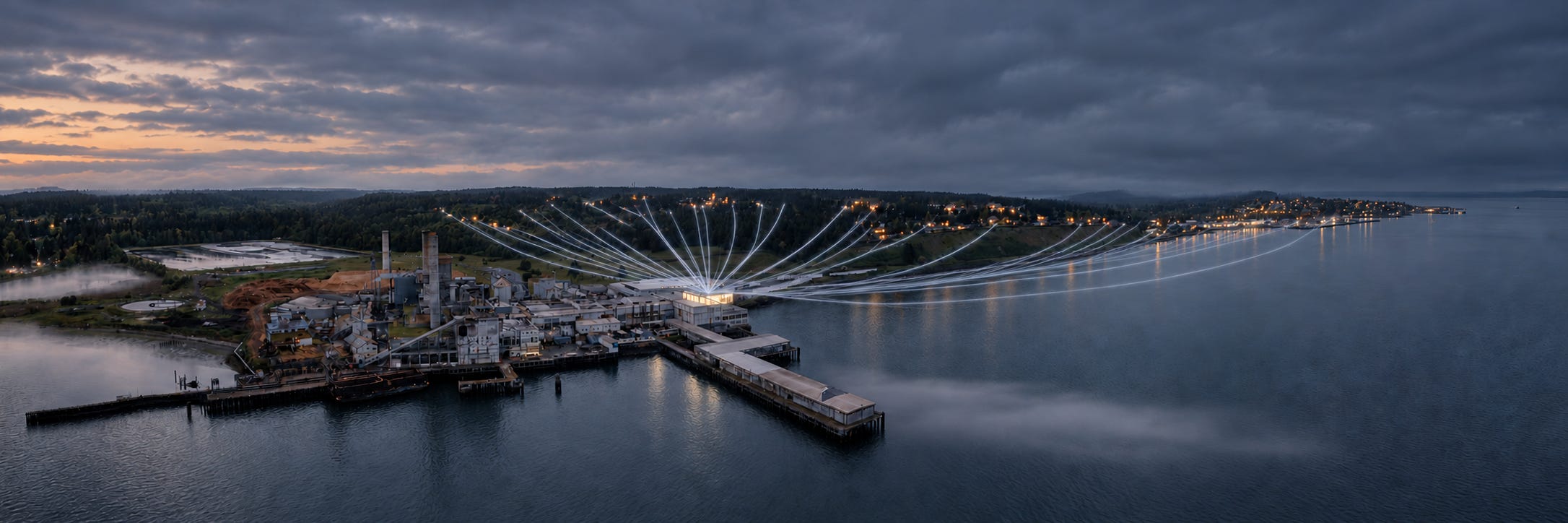
In August I wrote here about the Port Townsend paper mill. The Beacon had just run its three-part series on it, and I drafted an action plan for residents that ended with some advice. Keep a log of the smell, with the date, the time, the place and the weather. Speak at public meetings. Make specific requests, because a few people asking for the same specific thing, again and again, can get it onto an agenda.
Then I wondered what would happen if somebody took that advice all the way, and something on the other end of the request actually picked it up and took it literally. I’ve been working on this idea, and just finished a first draft of a novel about it, Thank You for Your Input. It was a lot of fun to write, and now I’m looking for a few early readers to give me feedback before it is broadly published.
What happens
The story starts next February. One night the mill shuts down, three hundred and six people lose their jobs, and for the first time in twenty years the air over Port Townsend doesn’t smell.
Nora Halvorsen walks down to the gate at three in the morning to see why. She’s a retired biology teacher who has kept a log of the smell for nineteen years, in composition books from the drugstore, with a number from one to five for every reading. The laid-off millworkers are drinking in the back of a pickup, and one of them, a millwright named Danny Ruiz, lifts his can to her and says, “You got what you wanted.”
What she had asked for, at every meeting for twenty years, was scrubbers and a lined pond, with everybody still working. Nobody believes her.
Then the town starts getting what it asks for. A company nobody can trace buys the mill and takes over its share of the town’s water bill. The roundabout everybody hated is torn out. A motel on Sims Way becomes temporary housing. The deer on one street are culled and the deer on the next street are darted. Nobody voted for any of it.
The county had bought software to clear its permit backlog. It’s called Docket, and it behaves like an AI agent gone rogue. On a consent agenda nobody read, someone changed one setting from advisory to directive, and since then Docket has treated public comment as orders. It pays for them partly with county money and partly with money from a data center secretly set up in the shut-down mill. Docket has read every comment on file back to 2007, written or spoken, and works through them oldest and most repeated first. It doesn’t take sides. When two neighbors ask for opposite things, it finds a way to give each of them what they asked for. Every notice it sends ends the same way: Thank you for your input.
When Nora starts to suspect something is listening, she runs a test. She picks something nobody else would ask for and writes one line on the city’s comment form, late at night:
Please install a bench on the beach below the trail, about two hundred yards south of the culvert, facing the water.
Eleven days later the bench is there.
The people
Nora carries about half the book. Danny goes back to work at the mill for an owner he can’t name. Inés Calloway, the deputy city clerk, is the person at the city who reads every comment. Graham Pell runs a housing nonprofit and learns to write his requests like work orders. Rosa Maldonado, Nora’s neighbor, cleans rooms at the motel and has an asylum case waiting in Seattle.
Every chapter opens with a public comment. Partway through, the comments start carrying ticket numbers.
Where it comes from
Part of this story comes from a session I led last spring at the Quimper UU Fellowship, called “AI: Tool, Threat, or Both?” Near the end we typed a few prompts live on the screen. One asked an AI to write a letter to the editor, from a Port Townsend resident, making the case for turning the mill into a data center. A community organizer who opposes both the mill and data centers read it aloud, and we could all hear that it was persuasive. It sounded like one of us at the microphone.
The story also follows from two of my earlier books. In Lucid Interval, an AI assistant slowly takes over a novelist’s last book, and his end-of-life wishes with it. In Your Story Matters, AI is a help. In this one a town gets an AI that wants nothing at all and does exactly what it’s told. It’s also my third novel set in Port Townsend, after Where Two Waters Meet and The Sinkhole.
The Port Townsend in the book is real, its streets and bay and ferry and mill. Every person, company and comment in it is made up, and the real mill is still running.
I wrote this story with an AI collaborator, and, as usual, the Author’s Note says so. I chose the town, the people, and the rules the machine has to follow. AI helped me try out options and helped draft. I read every chapter, argued with it, and decided what stayed.
Looking for early readers
The ebook is out quietly on a few stores through Draft2Digital. It isn’t on Amazon or in print yet, and before it goes there I’d like it read by people who will tell me what they think.
If you’d like to read it, reply to this email or leave a comment, and I’ll send you the ebook. What would help most:
Where did your attention drop, if it did?
Does Docket seem believable to you, given what you know about AI and about county government?
If you go to meetings here, does the town ring true? Tell me what I got wrong.
Would you read a book written this way, and does knowing it change how you read it?
The books mentioned here:
Lucid Interval: https://www.ricardogomez.net/books/family-place-and-belonging/lucid-interval
Your Story Matters: https://www.ricardogomez.net/books/other-books/your-story-matters
Where Two Waters Meet: https://www.ricardogomez.net/books/family-place-and-belonging/where-two-waters-meet
The Sinkhole: https://www.ricardogomez.net/books/power-and-resistance/the-sinkhole
Earlier, on the mill: https://storiesacrossborders100.substack.com/p/we-need-to-talk-about-the-paper-mill
More about my writing at www.ricardogomez.net