

Before the Inquisition, there was Toledo.
In the twelfth and thirteenth centuries, Toledo was the translation capital of the world. Jewish scholars worked alongside Muslim scholars and Christian clerics to render Arabic and Greek texts into Latin: Aristotle, Avicenna, Averroes, al-Khwarizmi. The knowledge that would fuel the European Renaissance did not emerge from European darkness. It was carried out of Iberia, through Toledo, by men of three faiths sitting at the same table. Al-Andalus, the Muslim-governed south of the Iberian peninsula, had built the most intellectually productive civilization in the medieval Western world. Its libraries, its medicine, its astronomy, its poetry were centuries ahead of what existed anywhere north of the Pyrenees.
I wrote a trilogy about that earlier moment, The Translators of Toledo, because the Toledo translation movement is one of history’s clearest demonstrations of what becomes possible when different traditions are allowed to work together. Three volumes, three generations, three languages, one city producing knowledge that Europe would spend the next three centuries building on.
This was not a paradise. Convivencia, the tradition of coexistence among the three Abrahamic communities, was never equal, never free of hierarchy or friction. But it was functional, and it was generative. Cultures built things together that none of them could have built alone.
It lasted roughly seven centuries. It took about one century to dismantle.
The fifteenth century is that century. It began with the three communities still living alongside each other in the cities of Castile and Aragon, under increasing pressure but still present. It ended in 1492 with three events in the same year, from the same monarchs: the fall of Granada, the last Muslim-governed city on the peninsula; the expulsion of every Jew who refused baptism; and the departure of Columbus from Palos de la Frontera, sailing west under the same royal seal, with the same ideological wind behind him.
The same mind that expelled the Jews funded the conquest of the Americas. The same intolerance that destroyed convivencia in Iberia was the operating system of colonization. This is not a coincidence or an irony the historians glossed over. It is the point.
Before writing about the century that ended this way, I wrote about the century that might have gone differently.
The Andalusian Covenant (subtitled The Other 1492) begins from one change to the historical record: Columbus is not the one who sails. In his place, a progressive coalition of Jews, Muslims, and Christians, facing expulsion from Granada, obtains his navigational charts and makes the crossing themselves. Before they sail, they draw up a founding document: the Covenant of the title. It commits them to leadership based on knowledge, not bloodline or creed, and to establishing relations of mutual learning and respect with whoever they find on the other side of the uncharted world.
The ship’s navigator is Miriam Cohen, a young Jewish woman who has been working in the Alhambra observatory disguised as a male scholar’s apprentice. When a storm hits in the Atlantic, her astronomical calculations save the fleet. After that she navigates openly. A Jewish woman from Granada is the first to find the western shore.
Once they reach the Americas, they build a settlement and initiate exchanges with the Taíno, the Muisca, the Inca, the Aztec, organized around the principles of the Covenant. Not conquest but knowledge sharing. The novel tracks what grows from that choice across generations.
Columbus never sailed. He died of an infected tooth in Madeira. Pizarro never conquered Peru. In this history, he was hired as a cook in the Inca embassy in Spain, where he learned to prepare quinoa and spent his life dreaming of travels he never made.
The novel asks the simplest possible question: the world the Andalusian Covenant built is the one we could have had. The world we actually got came from the same year, the same monarchs, the same Iberian peninsula, and made the opposite choices.
→ The Andalusian Covenant · El Pacto Andalusí
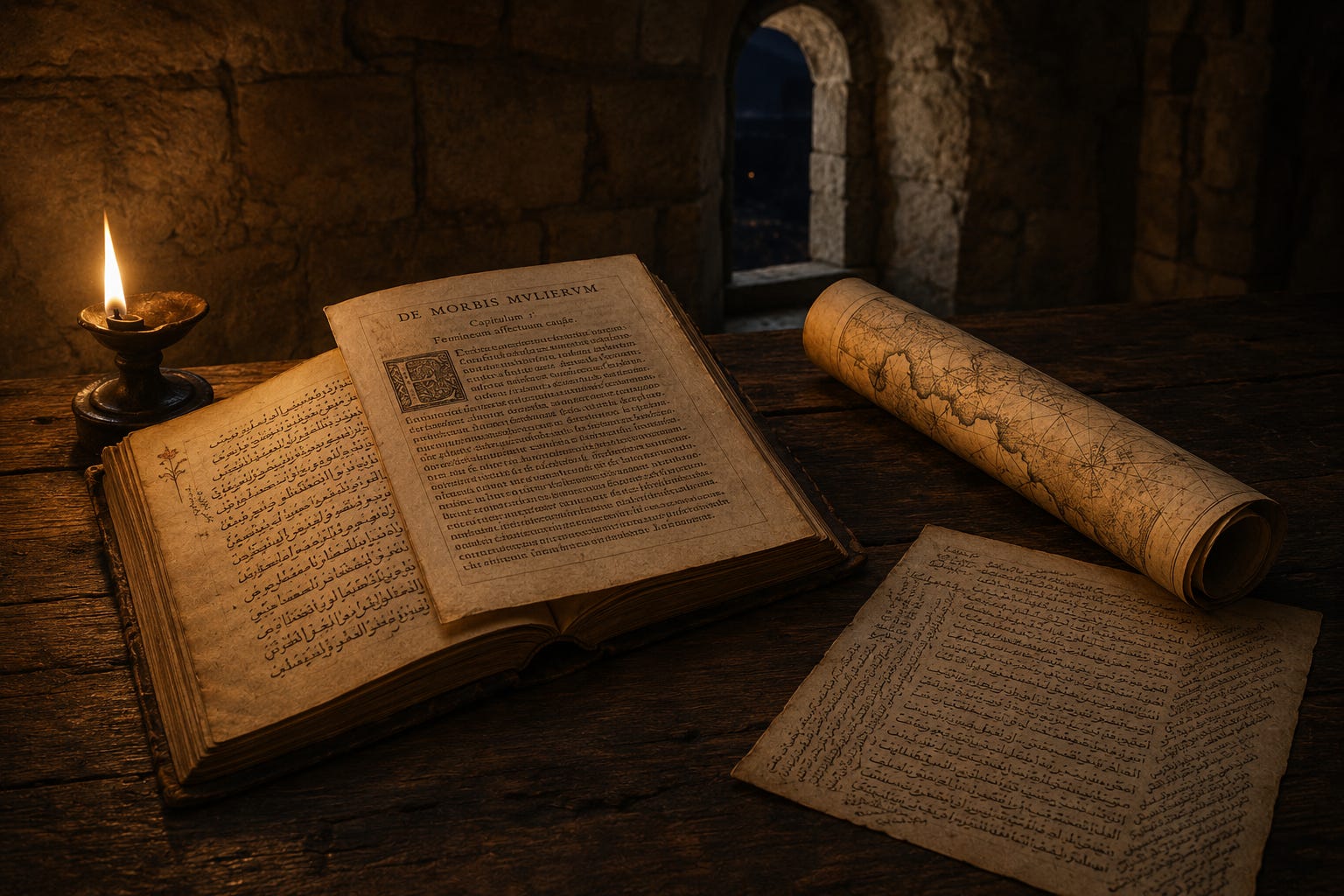
The Inquisition was not primarily a religious institution. It was a knowledge-control institution. Its targets were books, medical practices, astronomical models, legal traditions, languages: anything that carried the mark of a forbidden community. In 1499, Cardinal Cisneros ordered the Arabic manuscripts of Granada burned in the public square. Thousands of volumes fed the fire: medicine, philosophy, poetry, law. He permitted the medical texts to be saved.
That last sentence is the axis around which The Century of Silence turns. Three novels, three faiths, three forms of knowledge at risk. Each one illuminates a different face of what is being dismantled.
The Physician’s Proof (Seville and Córdoba, 1415–1420) follows Ishaq, a Jewish physician in Triana. His real medical texts, Avicenna, the Arabic tradition, the synthesis of Greek and Islamic medicine, he keeps turned to the wall behind Latin spines on his shelf. Every morning he checks them the way a man checks a door he has reason to check. The Laws of Valladolid have already restricted what Jews may practice. The Disputation of Tortosa has forced Jewish scholars before an ecclesiastical tribunal designed so that any answer confirms the predetermined conclusion. When a proceeding arrives at Ishaq’s practice and he must testify about his methods, the danger is not merely that he is a Jew practicing medicine. It is that his methods are empirical: he traces an epidemic through a neighborhood by mapping water sources and cross-referencing the sick against the cistern at Palma Street. A physician who looks for causes in the observable world is practicing a kind of thinking that competes with the kind of authority that locates all causes in God’s will. The knowledge at risk in this novel is the capacity to investigate: to follow evidence rather than doctrine, wherever it leads.
The Mapmaker’s Confession (Majorca, 1450–1460) moves thirty years forward and across the sea to the cartographic workshops of Palma, where a conversa, a woman whose family converted from Judaism a generation before, works at the table where her father trained her. She checks coastlines against his reference charts, finds his annotations still in the margins in his smaller, denser hand, and measures portolan charts with the precision of someone who learned to write by copying that hand. The knowledge at risk here is cartographic: maps that encode Arabic and Jewish geographical understanding, the accumulated learning of cultures that had been crossing these seas for centuries, in a form the Inquisition is beginning to understand. She receives two competing commissions. The confession of the title is what she must eventually reveal about what her maps contain and who, in their making, is still legible beneath the Christian surface. A converso is someone who has changed the name of what they know. The knowledge itself does not convert.
The Last Sermon (Granada, 1480–1492) closes in the city where everything ends. Yusuf is a Muslim librarian who spends the novel working through a Fez manuscript, folio forty-five, a text that distinguishes between two kinds of observation: the kind that confirms what the observer already knows, and the kind that records what the observer could not have anticipated. That distinction is the book’s argument. Empirical, open-ended inquiry is incompatible with authority that requires predetermined conclusions. Yusuf knows this. He watches the city narrow around him across five parts, the library in full, the war becoming real, the walls closing, and he keeps reading, keeps cataloguing, keeps making the list of what exists so that something will remain when the library does not. Chapter 31 is the last sermon. Chapter 33 is the transfer: what a librarian does when he can see what is coming and cannot stop it.
Here is the note that serves as epigraph on all three volumes: In November 1491, the Treaty of Granada guaranteed the Muslim population the right to practice their faith, maintain their mosques, and preserve their language and laws. In 1499, Cardinal Francisco Jiménez de Cisneros ordered the Arabic manuscripts of Granada burned in the public square. He permitted the medical texts to be saved.
The medical texts were saved because even the Inquisition needed physicians. The knowledge Ishaq spent his life preserving, under risk, in a consultation room in Triana, reached the fire and was exempted. That is not a happy ending. It is the most precise description the trilogy can offer of how knowledge survives persecution: partially, selectively, on terms set by the persecutors.
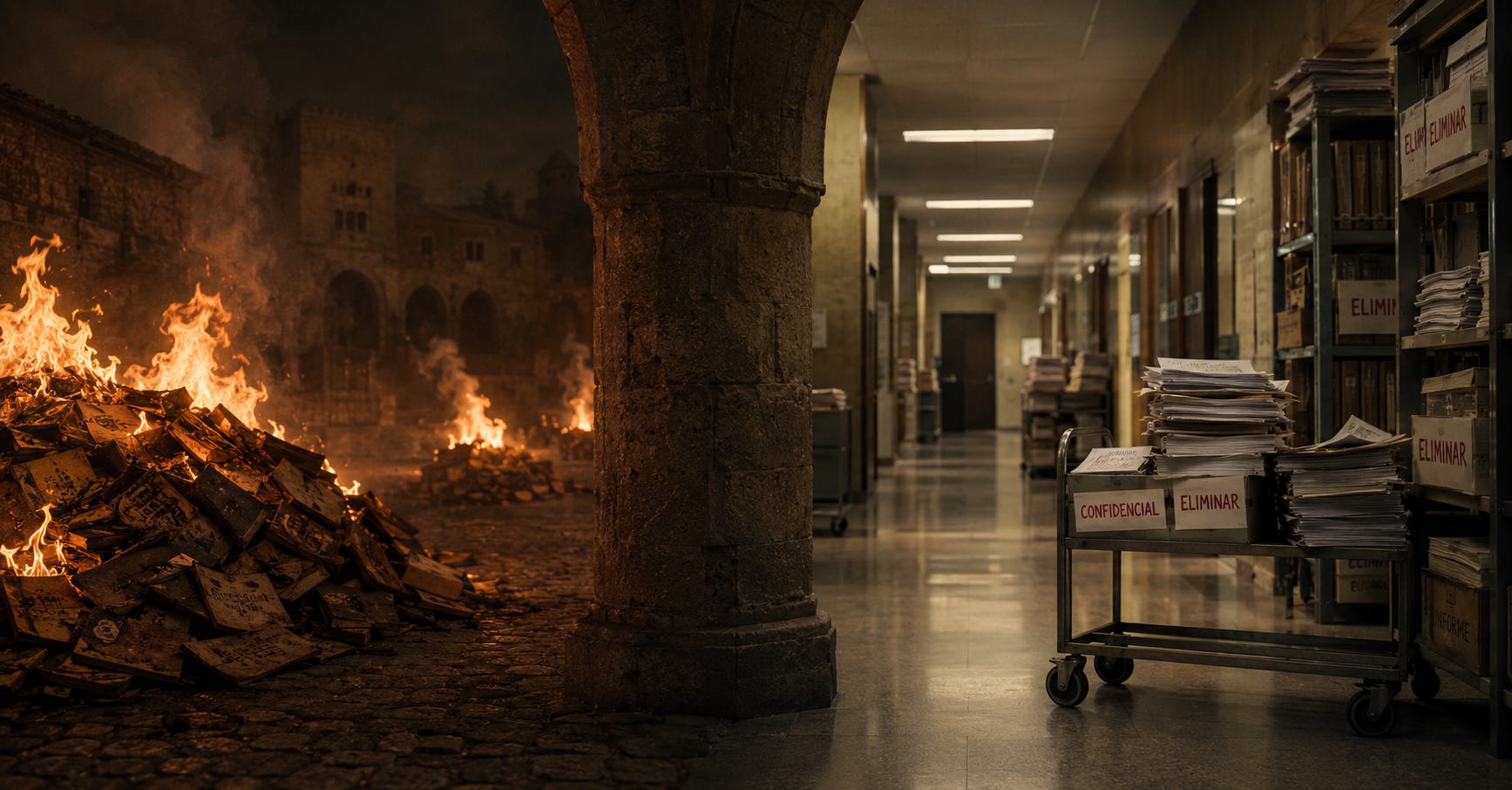
I keep returning to this history now because the mechanism is recognizable.
The time of the Convivencia did not collapse in a single edict. It collapsed through the accumulation of smaller moves: the 1391 pogroms that forced mass conversions and then made the converts suspect; the blood purity laws that made ancestry a legal category; the slow redefinition of pluralism as contamination; the replacement of civic accountability with loyalty to a single religious and political authority. Each step, taken alone, had its defenders. The pattern, taken together, was the end of something that had taken centuries to build.
The Inquisition in Medieval Spain is a reminder of is what is happening now in the United States.
The federal government under Trump has withdrawn or threatened funding from universities that refused to dismantle diversity programs, eliminate academic departments, or submit to political oversight of curriculum and hiring. More than four thousand book challenges have been filed in American schools and libraries in the past two years, targeting overwhelmingly books by authors of color and LGBTQ+ authors. The administration has invoked the Alien Enemies Act, a wartime statute from 1798, to deport people without due process, and has detained students on valid visas for their political speech. A travel ban targeting Muslim-majority countries was reinstated within days of the administration taking office. The Department of Justice has been turned toward prosecuting political opponents while abandoning public corruption cases. Pardons were granted en masse to people convicted of violent assault on the Capitol. Federal scientific agencies overseeing climate research, public health, and medicine have been defunded or placed under political supervision. The explicit language of Christian nationalism, the claim that the United States is and must be a Christian nation governed by Biblical principles, has moved from fringe to cabinet table.
Underneath all of it runs a level of personal financial self-dealing: the president’s own businesses receiving payments from foreign governments and domestic interests seeking favorable treatment, the open conversion of public office into private profit. It has no modern precedent in American democracy and considerable precedent in the history of authoritarian consolidation.
The Inquisition, too, was profitable for those who ran it. Confiscated property was divided between the crown and the Church. Persecution was an economic model as well as an ideological one.
I am not saying this is the fifteenth century. The institutions resisting the pressure are more numerous and more durable than those available to the physicians and librarians of Granada. But the project is recognizable: the narrowing of what knowledge is permitted, which communities belong, what faith is sanctioned, what questions may be asked. The fifteenth century did not announce itself as a catastrophe. It announced itself as a series of necessary measures, each one justified by the emergency of the moment.
The medical texts were saved. Not the poetry, not the philosophy, not the legal tradition, not the astronomical knowledge, not the language. The texts that the Inquisition needed were the texts the Inquisition kept.
We are still in the part where we get to decide what gets kept.
→ The Century of Silence
(EN): mybook.to/CenturyOfSilenceTrilog ·
(ES): mybook.to/SigloDelSilencio
→ The Translators of Toledo
(EN): mybook.to/TranslatorsofToledo
(ES): mybook.to/TraductoresDeToledo
→ The Andalusian Covenant
(EN): mybook.to/AndalusianCovenant
(ES): El Pacto Andalusí
Here is a brief video about the trilogy: