
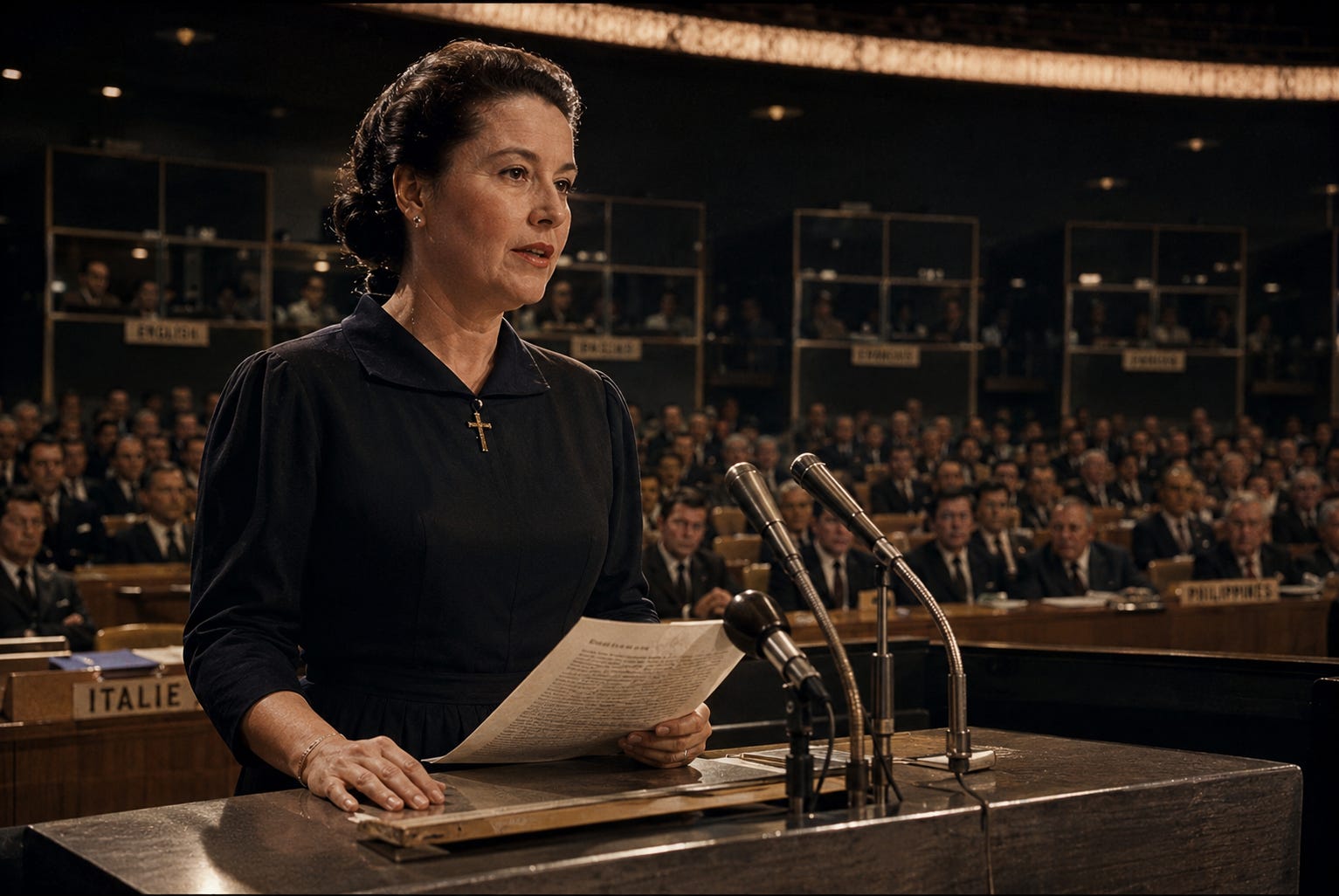
My grandmother stood before the United Nations in the 1950s and told an international assembly that their declarations were not enough.
She said it plainly. The Universal Declaration of Human Rights had been adopted in 1948. Article 2 guaranteed rights and freedoms without distinction of any kind. My grandmother — Enriqueta, whom everyone called Keketa — stood in New York in the years that followed and said: declaring these things is not the work. The work is going to the villages and explaining them. She quoted the literacy rate: forty-five percent of rural Latin American women could not read. She said that rights on paper that do not reach the people they are meant to protect are not rights. They are intentions.
She was from a conservative Catholic family in Colombia. She had studied, married, raised children, managed a household across decades that included a civil war, the Great Depression, a political assassination that shattered the country, and another ten years of internal violence so brutal that Colombians still call it simply La Violencia, as if no other word were needed. She was not someone who moved through the world making dramatic gestures. She was someone who thought seriously about the world she was given to live in, and went to say what she thought where she believed it needed to be said.
She delivered one speech before the World Union of Catholic Women and another before the United Nations. Then she stopped.
Nineteen years of silence. No public speeches, no writing, no record of anything said outside the house.
In 1969, she opened a notebook and wrote her memoirs.
The first line — she apologized. A nadie, creo yo, le interesan estas cosas que escribo, tal vez solo para mí, para papá, ya muerto y para mamá. Nobody, I think, is interested in the things I write, maybe only for me, for father, already dead, and for mother.
The notebook is real. The speeches are real. I found them — the speeches in a cardboard box my mother had kept, mixed in with newspaper clippings and photographs; the memoir discovered later by my cousins among her papers. The speeches are typed on thin paper with corrections in pen. The handwriting in the memoir is precise and careful, the formal Spanish of someone who learned to write in another century.
What the documents do not say: what the silence cost her. What she was thinking during those nineteen years. Why she stopped, and what finally made her return to the notebook. Whether she believed what she wrote at the top of that first page, or whether she wrote it as a kind of armor.
Those are the silences the novel had to fill.
The Keketa Papers follows Keketa’s family across two centuries of Colombian history: the hacienda at Fagua, the War of a Thousand Days seen through the unlikely friendship between two men on opposite sides, a treasure hunter who searched for Chibcha gold under the house and found a pre-colonial aqueduct instead, a grandfather whose business collapsed behind a cathedral in London. The novel’s center is Keketa herself: not the woman at the UN podium, though she is there, but the woman who thought the world would not be interested in what she had to say, and who wrote it down anyway.
The last line of her first page is the line the novel is written to answer. She was wrong that no one would be interested. The Keketa Papers is proof of that, in whatever way a novel can be proof of anything.
I am experimenting with a conversation-style podcast about this novel, using NotebookLM. See the companion post to check it out and let me know what you think.
In addition, I created this short (1 min) video to talk about it.
The Keketa Papers — a novel about what women choose not to say.
The Keketa Papers is available in English and in Spanish as Memorias de Keketa.
English → mybook.to/TheKeketaPapers Español → mybook.to/MemoriasKeketa